I have remarked before, and I am sure you have too, about the coincidences (?) of themes that suddenly appear. You hear, for instance, a certain word or about a certain subject and suddenly it seems to appear again and again. I imagine that is because we have been alerted and now we see, but all the same it seems worth attending to the alert. Maybe something is being brought to our attention.
Today it was about choice. I started a new book of Mary Oliver's poetry called: Evidence. At the beginning before the poetry begins there is a quote from Soren Kierkegaard which says: We create ourselves by our choices. For whatever reason that kind of stopped me dead for a moment. We create ourselves by our choices. Is it true?
In the same reading session, still reading the book by Desmond and Mpho Tutu I found that I was beginning a chapter called, Free to Choose. Is that a coincidence? It hit me because I always used to find myself qualifying statements about the power of choice in our lives by asking 'how much freedom do we really have? Are we not to quite a strong extent limited by upbringing? by personality? by life circumstances? But I think what the Tutu's are saying about this is really really vital.
Choice is a freedom each person has. God invests each of us with the freedom to choose. ...We have the freedom to choose right. But that would be meaningless if there were not also the possibility that we could choose wrong.
The chapter then goes on to look at the parable of the Prodigal Son in which the younger son takes his father's money, the inheritance he would have received upon his father's death, and squanders it. When he spends it all he decides to return home not sure, of course, how he will be received, but his father seeing him a long way off, runs to greet him, embraces him, and celebrates his return. There is of course, much more to the story but part of the point the Tutus want to make is about the father's response.
The breadth of God's forgiveness, the depths of God's love, and the grace to wait - true wisdom for parenting - are all displayed in this simple story.
The powerful powerlessness of parenting is akin to the self-imposed impotence of God in the face of our choices. Like the father in the parable who just sits there day after day helpless - in a way - God is not willing to do anything to infringe upon our freedom...In the parable we see the father's longing. We can imagine him stepping out of his house each day to sit where he can watch the long road...then finally, one day, waaaay over theeereee in the distance he sees a figure approach...he runs...to meet his child.
But there is another and just as important aspect of this whole business of the freedom of choice and that is that we are not just left to our own devices to muddle through our choices on our own. The shepherd of Luke's Gospel parable lets us see that God honors our choices yet seeks us out.
It is the seeking out, the accompanying, the embracing that keep us from being crushed by our destructive choices. Kierkegaard says that all our choices make us who we are and God is saying, they don't have to destroy you, my love will create a thing of beauty in your heart and of your life. You can choose to let me.
Thursday, January 10, 2013


Friday, January 4, 2013
The New Year in graciousness
Already we are four days into the new year and I am only now getting back to the blog. As with many folks over this holiday I spent a fair number of days flat out with a cold and no energy to write. But now...
I received several lovely and inspiring books at Christmas. It always seems a gift to hear and absorb the wisdom of good people. I would like to share from one of them: Made for Goodness by Desmond and Mpho Tutu and from a book of poetry I have had but not read for a while by Mary Oliver, called Thirst.
First, from Mary Oliver's book of poetry. You will perhaps be familiar with this poem - it is called When I am Among the Trees. The first two verses struck me as being perfect to begin the new year with for those of us who may find ourselves still rushing through life:
When I am among the trees,
especially the willows and the honey locust,
equally the beech, the oaks and the pines,
they give off such hints of gladness.
I would almost say they save me, and daily.
I am so distant from the hope of myself,
in which I have goodness and discernment,
and never hurry through the world
but walk slowly, and bow often.
I find myself deeply touched by those last two lines. Can I learn to walk more slowly through the world and then, filled with wonder and gratitude, bow often. I sense that if we could do that, our world would be pretty close to perfect because there is such respect and thanksgiving.

And then from Desmond and Mpho Tutu's book which is about the beautiful generosity and graciousness of God's love. This too is a poem and they have introduced it by saying: But first turn with us into the stillness and listen to God speak with the voice of the heart:
Don't struggle and strive so, my child
There is no race to complete, no point to prove, no obstacle course to
conquer for you to win my love.
I have already given it to you.
Of course, you really want to read the whole of both these poems and indeed, both of these books. But what I read just filled me with a wonderful sense that the beginning of a new year can be immensely hopeful and immensely graceful no matter the state of the world around us.
(Thirst by Mary Oliver, Beacon Press, Boston, 2006; Made for Goodness and why this makes all the difference by Desmond Tutu and Mpho Tutu, HarperCollins, 2010)
I received several lovely and inspiring books at Christmas. It always seems a gift to hear and absorb the wisdom of good people. I would like to share from one of them: Made for Goodness by Desmond and Mpho Tutu and from a book of poetry I have had but not read for a while by Mary Oliver, called Thirst.
First, from Mary Oliver's book of poetry. You will perhaps be familiar with this poem - it is called When I am Among the Trees. The first two verses struck me as being perfect to begin the new year with for those of us who may find ourselves still rushing through life:
When I am among the trees,
especially the willows and the honey locust,
equally the beech, the oaks and the pines,
they give off such hints of gladness.
I would almost say they save me, and daily.
I am so distant from the hope of myself,
in which I have goodness and discernment,
and never hurry through the world
but walk slowly, and bow often.
I find myself deeply touched by those last two lines. Can I learn to walk more slowly through the world and then, filled with wonder and gratitude, bow often. I sense that if we could do that, our world would be pretty close to perfect because there is such respect and thanksgiving.

And then from Desmond and Mpho Tutu's book which is about the beautiful generosity and graciousness of God's love. This too is a poem and they have introduced it by saying: But first turn with us into the stillness and listen to God speak with the voice of the heart:
Don't struggle and strive so, my child
There is no race to complete, no point to prove, no obstacle course to
conquer for you to win my love.
I have already given it to you.
Of course, you really want to read the whole of both these poems and indeed, both of these books. But what I read just filled me with a wonderful sense that the beginning of a new year can be immensely hopeful and immensely graceful no matter the state of the world around us.
(Thirst by Mary Oliver, Beacon Press, Boston, 2006; Made for Goodness and why this makes all the difference by Desmond Tutu and Mpho Tutu, HarperCollins, 2010)
Friday, December 14, 2012
Advent and life
I have not been very good these last few weeks about writing this blog. Partly it is because I don't want to write just for the sake of writing. I want rather, to try to say something in which we all might find at least a little bit of nourishment of one kind or another.
But now we are well into Advent which is one of my favourite times of the 'religious' year. Advent talks about someone coming who will make a difference in our lives. Someone who is love and who cherishes each of us with all our gifts and meannesses and worries and burdens.
I have just been re-reading (for the umpteenth time) Sr Wendy Beckett's beautiful book 'Sr Wendy on Prayer' (Continuum, 2006)and found a couple of passages I wanted to share. I think they are difficult because they leave us a bit vulnerable but I think she means to challenge us to a spiritual adulthood . She is talking about 'does prayer work?':
Almost invariably when one talks about prayer, people think it is about asking God for something...It may seem to us we are asking God to give us something - good weather, good health, good exam results - and that of course, is our explicit intention. Since God is not a puppet-master who will stretch out and change the weather, adjust the cells of our body or jiggle with the examiners markings, and, at a deeper level we know this; the essential nature of our plea is not that God will change the real world, but will strengthen us to bear the impact of it.
She goes on to say: Life is unpredictable. Tragedy and comedy come down upon us without warning...We would like God to change these stresses. This will not happen. What will happen is God's support in making everything in our lives a means of deepening our capacity to be human. Not God the puppet-master ... but a God who has resolutely refused to people the world with puppets. God has paid us the compliment of creating us as free and intelligent,, able to choose and reject and look clearly at the truth.
I find myself reacting to this strongly because I want a God who can save me from myself in an almost physical way. And yet, I am coming to recognize that it is because of my ability to choose, my ability to let suffering transform me, my ability to try to let other people be themselves that I have the chance to grow up and be as fully human as I can be.
I think of the images we use at Christmas. There is is the image of a small, vulnerable baby - there is a chance here that this special child might never grow up, might be hurt or killed before the time of his mission. That is an amazing thing to me. Then even at Christmas there are shadowings of the suffering and darkness of human hubris to come so it is not all light and joy but a very human journey that is beginning. In this man's life we are shown how to live fully in our vulnerability and gifts.
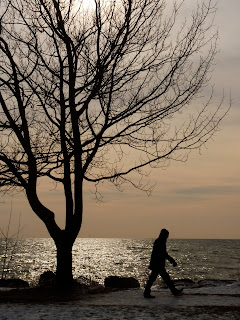
Finally, one of my other teachers has this to say about our human journey:
We would all like to have the time to sit and appreciate the stillness that comes from doing nothing. But if we were given the time, would we be able to be still and quiet? That is the problem with many of us. We complain that we don't have the time to rest, to enjoy being here. But we are used to always doing something. We have no capacity to rest and do nothing...We are workaholics. ...That is why learning how to be right where we are without doing anything is a very important practice, as well as a very challenging one. (Thich Nhat Hanh:Keeping the Peace)
Wouldn't it be a wonderful way to celebrate this season of gift and joy if we could just be present to each moment with our families, our friends, our life's journey and not let any moment go by without living it as fully as we possibly can?
But now we are well into Advent which is one of my favourite times of the 'religious' year. Advent talks about someone coming who will make a difference in our lives. Someone who is love and who cherishes each of us with all our gifts and meannesses and worries and burdens.
I have just been re-reading (for the umpteenth time) Sr Wendy Beckett's beautiful book 'Sr Wendy on Prayer' (Continuum, 2006)and found a couple of passages I wanted to share. I think they are difficult because they leave us a bit vulnerable but I think she means to challenge us to a spiritual adulthood . She is talking about 'does prayer work?':
Almost invariably when one talks about prayer, people think it is about asking God for something...It may seem to us we are asking God to give us something - good weather, good health, good exam results - and that of course, is our explicit intention. Since God is not a puppet-master who will stretch out and change the weather, adjust the cells of our body or jiggle with the examiners markings, and, at a deeper level we know this; the essential nature of our plea is not that God will change the real world, but will strengthen us to bear the impact of it.
She goes on to say: Life is unpredictable. Tragedy and comedy come down upon us without warning...We would like God to change these stresses. This will not happen. What will happen is God's support in making everything in our lives a means of deepening our capacity to be human. Not God the puppet-master ... but a God who has resolutely refused to people the world with puppets. God has paid us the compliment of creating us as free and intelligent,, able to choose and reject and look clearly at the truth.
I find myself reacting to this strongly because I want a God who can save me from myself in an almost physical way. And yet, I am coming to recognize that it is because of my ability to choose, my ability to let suffering transform me, my ability to try to let other people be themselves that I have the chance to grow up and be as fully human as I can be.
I think of the images we use at Christmas. There is is the image of a small, vulnerable baby - there is a chance here that this special child might never grow up, might be hurt or killed before the time of his mission. That is an amazing thing to me. Then even at Christmas there are shadowings of the suffering and darkness of human hubris to come so it is not all light and joy but a very human journey that is beginning. In this man's life we are shown how to live fully in our vulnerability and gifts.

Finally, one of my other teachers has this to say about our human journey:
We would all like to have the time to sit and appreciate the stillness that comes from doing nothing. But if we were given the time, would we be able to be still and quiet? That is the problem with many of us. We complain that we don't have the time to rest, to enjoy being here. But we are used to always doing something. We have no capacity to rest and do nothing...We are workaholics. ...That is why learning how to be right where we are without doing anything is a very important practice, as well as a very challenging one. (Thich Nhat Hanh:Keeping the Peace)
Wouldn't it be a wonderful way to celebrate this season of gift and joy if we could just be present to each moment with our families, our friends, our life's journey and not let any moment go by without living it as fully as we possibly can?
Monday, November 26, 2012
Recurring themes in life
You know, it is interesting how often some theme or some word keeps appearing in your life after you first notice it. In this case I am thinking of 'vulnerability' 'weakness'.
A weekend ago I was in Tennessee at a retreat for people who are caregivers. It was meant to be about 'The Spirituality of Caregiving' so that it was not about how to care for someone but more about how to care for the caregiver. One of the themes that arose there was that caregivers feel they need to be strong and they often go on and on without a break or without admitting that they need a break. But here, in the atmosphere of a group who understood, there was the opportunity for people to say 'I am tired', 'I myself feel vulnerable', 'I sometimes think thoughts about the one I care for that I can hardly bear'.
Later, during the same weekend we attended a meeting that was focused on the message of Henri Nouwen's life and books and how it might speak to people now, in this 21st century. The strongest theme that arose was the awareness that Henri was speaking out of his own weakness, his own very great need and vulnerability. But because he helps us to see that it is okay to be weak, that it is okay to be a mess we can be encouraged. Because what he also makes wonderfully clear is that we are so beloved of God even when we fall apart or act badly that we can stop trying to be what we are not: strong. We all agreed however, that in this world where strength and success and never failing are built into the way of our society this is not a message that people want to hear.
Then, when I returned home and was reading more from the book I mentioned in my last blog - the one by Joan Chittister, I found the theme again. Here's what she had to say:
Vulnerability is clearly part of the spiritual process, clearly part of the human endeavor. To know ourselves to be exposed to forces outside ourselves, beyond our control, teaches us the power of both darkness and light, gives us gifts from the depths of the unknown, introduces us to the mystery of life...We are put in a position where we have no choice but to go out of ourselves to others in order to draw from them what we ourselves would otherwise be left without. Vulnerability gives us the gift of our own limitations and from the darkness of despair we learn to trust in the gifts of those who are seeking our own giftedness in return.
And then, to all that, add something from Thich Nhat Hanh which sort of topped everything off:
We have to wake up to the fact that everything is connected to everything else. Our safety and well-being cannot be individual matters any more. If others are unsafe, there is no way we can be safe.
So, I feel like there is a strong message in all of this that says both that we are all weak and vulnerable and in need of one another and also, that that is just fine!
A weekend ago I was in Tennessee at a retreat for people who are caregivers. It was meant to be about 'The Spirituality of Caregiving' so that it was not about how to care for someone but more about how to care for the caregiver. One of the themes that arose there was that caregivers feel they need to be strong and they often go on and on without a break or without admitting that they need a break. But here, in the atmosphere of a group who understood, there was the opportunity for people to say 'I am tired', 'I myself feel vulnerable', 'I sometimes think thoughts about the one I care for that I can hardly bear'.
Later, during the same weekend we attended a meeting that was focused on the message of Henri Nouwen's life and books and how it might speak to people now, in this 21st century. The strongest theme that arose was the awareness that Henri was speaking out of his own weakness, his own very great need and vulnerability. But because he helps us to see that it is okay to be weak, that it is okay to be a mess we can be encouraged. Because what he also makes wonderfully clear is that we are so beloved of God even when we fall apart or act badly that we can stop trying to be what we are not: strong. We all agreed however, that in this world where strength and success and never failing are built into the way of our society this is not a message that people want to hear.
Then, when I returned home and was reading more from the book I mentioned in my last blog - the one by Joan Chittister, I found the theme again. Here's what she had to say:
Vulnerability is clearly part of the spiritual process, clearly part of the human endeavor. To know ourselves to be exposed to forces outside ourselves, beyond our control, teaches us the power of both darkness and light, gives us gifts from the depths of the unknown, introduces us to the mystery of life...We are put in a position where we have no choice but to go out of ourselves to others in order to draw from them what we ourselves would otherwise be left without. Vulnerability gives us the gift of our own limitations and from the darkness of despair we learn to trust in the gifts of those who are seeking our own giftedness in return.
And then, to all that, add something from Thich Nhat Hanh which sort of topped everything off:
We have to wake up to the fact that everything is connected to everything else. Our safety and well-being cannot be individual matters any more. If others are unsafe, there is no way we can be safe.
So, I feel like there is a strong message in all of this that says both that we are all weak and vulnerable and in need of one another and also, that that is just fine!
Thursday, November 15, 2012
The gift of silence
I am often finding things in the books I read that I want to share. Usually these are 'aha!' things and they hit something deep in me that seem worth pondering. So, the book this time is called: Heart of Flesh by Joan Chittister (Erdmans Publishing Co. and Novalis, 1998). I very much like her writing and this book, though not new, says a lot of things about women and the Catholic church especially. But the aha thing is a bit different.
Sr Joan says: Talk without thought is useless. What we may need most is interior quiet in a culture of boom boxes, agitation, and perpetual motion. We need space to think in culture bombarded by sound, most of it vacuous, much of it extraneous, a great deal of it self-centered. We have a culture forever geared to mending the way we talk when it may be silence that is lacking. Then she goes on to say something that I feel is so worth thinking about:
Silence is not an empty thing. Silence is full of what we need to learn about ourselves.
Silence is not an empty thing. I can recall when I first entered the monastery. I came from a life not only very busy and full of talk, but one full of my own woundedness. Stepping from that world into a day full of silence was without question, an immense shock to the system. Of course, there were still times when we spoke, but in comparison they were few. What I very quickly found was that there were things going on in my head and my heart that I found hard to bear, even frightening. I was perhaps for the first time, facing things in myself that I had avoided for my whole life. It was so hard. And, paradoxically, it was so healing.
The odd thing too that I soon discovered, was that for all the raw hurt and hard stuff within me, the silence was quite gentle and amazingly loving. How can silence be gentle and loving - I would say because in the silence there is God leading and healing. But whatever is happening it was a gift.
It is so often said that for many people it is necessary to hit the bottom before you can rise to the surface. I know that is true from my own experience and it happened in the silence. Of course, that kind of huge immersion is not what most people need or desire. But daily times of silence where there is just you and your innermost self can be as healing as most people need. But the more we plug in the music or turn on the TV or gather is large noisy groups at the pub, the harder it is to find your own inner centre of beauty and peace.

Here is something else that Sr Joan says in her book: Communication theorists tell us, in fact, that over 80 percent of every message is communicated non-verbally. What I believe in my heart will show in my body.
Wow. That could really be helpful in leading us to become both more self-aware and also, more attuned in the silence of listening, to what others are really saying to us.
Sr Joan says: Talk without thought is useless. What we may need most is interior quiet in a culture of boom boxes, agitation, and perpetual motion. We need space to think in culture bombarded by sound, most of it vacuous, much of it extraneous, a great deal of it self-centered. We have a culture forever geared to mending the way we talk when it may be silence that is lacking. Then she goes on to say something that I feel is so worth thinking about:
Silence is not an empty thing. Silence is full of what we need to learn about ourselves.
Silence is not an empty thing. I can recall when I first entered the monastery. I came from a life not only very busy and full of talk, but one full of my own woundedness. Stepping from that world into a day full of silence was without question, an immense shock to the system. Of course, there were still times when we spoke, but in comparison they were few. What I very quickly found was that there were things going on in my head and my heart that I found hard to bear, even frightening. I was perhaps for the first time, facing things in myself that I had avoided for my whole life. It was so hard. And, paradoxically, it was so healing.
The odd thing too that I soon discovered, was that for all the raw hurt and hard stuff within me, the silence was quite gentle and amazingly loving. How can silence be gentle and loving - I would say because in the silence there is God leading and healing. But whatever is happening it was a gift.
It is so often said that for many people it is necessary to hit the bottom before you can rise to the surface. I know that is true from my own experience and it happened in the silence. Of course, that kind of huge immersion is not what most people need or desire. But daily times of silence where there is just you and your innermost self can be as healing as most people need. But the more we plug in the music or turn on the TV or gather is large noisy groups at the pub, the harder it is to find your own inner centre of beauty and peace.

Here is something else that Sr Joan says in her book: Communication theorists tell us, in fact, that over 80 percent of every message is communicated non-verbally. What I believe in my heart will show in my body.
Wow. That could really be helpful in leading us to become both more self-aware and also, more attuned in the silence of listening, to what others are really saying to us.
Sunday, November 11, 2012
War and invisible things
Two thoughts have come to mind today - which is Remembrance Day in many countries.
This week I met a new friend. This woman is a bit older than I am and we met through a mutual friend. My new friend is from Bavaria and one of things she shared with me was a bit about her life in Germany during the war. My friend worked in the Messerschmidt factory and there met her husband. She showed me an article from a newspaper about her work and in it was a photo of her with a handsome young Luftwaffe pilot. Perhaps he was a pilot who dropped bombs on London...
Our meeting being so close to Remembrance Day raised some conflicting emotions in me. I could remember my own war time childhood here in Canada - the things we said and wrote about the Germans and the Japanese (which is another reflection because my hairdresser is Japanese). They were the enemy. But now, they are friends. Did we ever think this would be possible? Perhaps not. But I am glad that I have met my new friend, glad that we do not have to hate one another.
But... did we ever really have to hate each other? We were told they were our enemies and it is true, they were causing us harm. But were they/are they not also children of God? A God who loves all of us however badly we may act toward one another. I have said this before, I know, but I want to keep saying it: do we have to see others as enemies? Do we have to hate others even when they act badly? I am not suggesting we not defend ourselves or our country or our families if they are attacked. But that still doesn't mean we have to hate - or so it seems to me.
The other thought that came to mind today: how amazing and beautiful are some unseen things. What am I thinking of? Well, this morning I was looking up at the blue sky... a rather rare vision these grey days of November. And I remembered a software program designed by my nephew called Starry Night. In that program you can turn off the daylight and see the stars that are shining right now. So when I look up at the blue sky I know the stars are there, still shining beautifully away, but I cannot see them. Wow.
Another thing we cannot see which is amazing is the air we breathe. We take it so much for granted and yet, it is just ...there. We can't, strictly speaking, see love either but as with the other things, we can experience their effects. We know when someone loves us, we know that there is air to breath because we are still alive and even the stars - because don't the scientists tell us we are made of stardust? Perhaps most of all, we cannot quite see God - but I believe in God's existence and I believe I see God's love all around me.
Are these two thoughts related? I don't know but I guess it would be a lovely thing if we could spend more time being amazed and grateful for the air and the stars and love and God and share that amazement and gratitude with others so that maybe that would destroy the hate.
This week I met a new friend. This woman is a bit older than I am and we met through a mutual friend. My new friend is from Bavaria and one of things she shared with me was a bit about her life in Germany during the war. My friend worked in the Messerschmidt factory and there met her husband. She showed me an article from a newspaper about her work and in it was a photo of her with a handsome young Luftwaffe pilot. Perhaps he was a pilot who dropped bombs on London...
Our meeting being so close to Remembrance Day raised some conflicting emotions in me. I could remember my own war time childhood here in Canada - the things we said and wrote about the Germans and the Japanese (which is another reflection because my hairdresser is Japanese). They were the enemy. But now, they are friends. Did we ever think this would be possible? Perhaps not. But I am glad that I have met my new friend, glad that we do not have to hate one another.
But... did we ever really have to hate each other? We were told they were our enemies and it is true, they were causing us harm. But were they/are they not also children of God? A God who loves all of us however badly we may act toward one another. I have said this before, I know, but I want to keep saying it: do we have to see others as enemies? Do we have to hate others even when they act badly? I am not suggesting we not defend ourselves or our country or our families if they are attacked. But that still doesn't mean we have to hate - or so it seems to me.
The other thought that came to mind today: how amazing and beautiful are some unseen things. What am I thinking of? Well, this morning I was looking up at the blue sky... a rather rare vision these grey days of November. And I remembered a software program designed by my nephew called Starry Night. In that program you can turn off the daylight and see the stars that are shining right now. So when I look up at the blue sky I know the stars are there, still shining beautifully away, but I cannot see them. Wow.
Another thing we cannot see which is amazing is the air we breathe. We take it so much for granted and yet, it is just ...there. We can't, strictly speaking, see love either but as with the other things, we can experience their effects. We know when someone loves us, we know that there is air to breath because we are still alive and even the stars - because don't the scientists tell us we are made of stardust? Perhaps most of all, we cannot quite see God - but I believe in God's existence and I believe I see God's love all around me.
Are these two thoughts related? I don't know but I guess it would be a lovely thing if we could spend more time being amazed and grateful for the air and the stars and love and God and share that amazement and gratitude with others so that maybe that would destroy the hate.
Sunday, November 4, 2012
Where's the courage?
As the American election process draws to a close (thankfully) I have found myself thinking a lot about how hard it seems to be courageous these days. I'm thinking at the moment, of courageousness in public life but that is probably only a reflection of our own individual lives as well.
What am I thinking about? Well, if you read the media coverage, most people are fed-up with political-speak. Perhaps Mr Romney is the worst example but it is hard to find a public figure who is prepared to speak clearly and with integrity about their values on virtually any issue. To hear interviews with almost any politician, is to hear a kind of vapour - almost never a straight, clear answer. 'Tell me sir, in view of this decision, what are likely to be the implications?' 'Well, I am so glad you asked that question. Our party has shown how effective it has been in the past in understanding what the people want so you can be sure, we will do the right thing'. Are we any wiser? Have we learned what are the implications of whatever the decision is?
Why don't politicians speak clearly and simply? I assume that the reason they do not is that once elected they want to stay elected and so they think they need to please 'the voters'. If previously they had any core values, these pretty much evaporate once elected. It is, in my opinion, one of the downsides of democracy. That Mr Romney and President Obama have spent how many billions of dollars on their campaign ads is scandalous. But it would at least be slightly less scandalous if we were one bit better informed about what they stand for. This essentially also applies to our politicians here in Canada except that they are not permitted to spend so much money.
What I am seeing here is a such a lack of courage to speak the truth that it makes me want to weep for our future. I know it is hard, I know it can be costly to be courageous - as it was for Jesus -but without that, without truth, without integrity, what kind of world are we creating? Wouldn't it be wonderful if there were some world leaders who could say for instance, 'Let's stop speaking about other people or places, as enemies and let's talk together to see if there is a way to peace'. Or perhaps to say, 'I'm not sure what the way forward is, but let's work together - all of us, toward what is the very best we can do'.
I know why I have lacked courage in the past. I lacked courage because I was afraid; afraid of the consequences of speaking the truth or taking a difficult or unpopular stand. I wasn't ready to pay the price. But then, I look at Jesus - because that is my heritage - and I see a man who with compassion and love, spoke truth to power and of course, in the end he died for it. But he left us an example of what is possible. His courage made our world a better place.
In many small ways every day is it possible for us to be more courageous and truth-full? Would that then make it easier for our leaders to be so too? Would that then mean we could build a society we could be proud of and in which we could live to our fullest humanity? I believe that to be so.
I'm going to start today.
What am I thinking about? Well, if you read the media coverage, most people are fed-up with political-speak. Perhaps Mr Romney is the worst example but it is hard to find a public figure who is prepared to speak clearly and with integrity about their values on virtually any issue. To hear interviews with almost any politician, is to hear a kind of vapour - almost never a straight, clear answer. 'Tell me sir, in view of this decision, what are likely to be the implications?' 'Well, I am so glad you asked that question. Our party has shown how effective it has been in the past in understanding what the people want so you can be sure, we will do the right thing'. Are we any wiser? Have we learned what are the implications of whatever the decision is?
Why don't politicians speak clearly and simply? I assume that the reason they do not is that once elected they want to stay elected and so they think they need to please 'the voters'. If previously they had any core values, these pretty much evaporate once elected. It is, in my opinion, one of the downsides of democracy. That Mr Romney and President Obama have spent how many billions of dollars on their campaign ads is scandalous. But it would at least be slightly less scandalous if we were one bit better informed about what they stand for. This essentially also applies to our politicians here in Canada except that they are not permitted to spend so much money.
What I am seeing here is a such a lack of courage to speak the truth that it makes me want to weep for our future. I know it is hard, I know it can be costly to be courageous - as it was for Jesus -but without that, without truth, without integrity, what kind of world are we creating? Wouldn't it be wonderful if there were some world leaders who could say for instance, 'Let's stop speaking about other people or places, as enemies and let's talk together to see if there is a way to peace'. Or perhaps to say, 'I'm not sure what the way forward is, but let's work together - all of us, toward what is the very best we can do'.
I know why I have lacked courage in the past. I lacked courage because I was afraid; afraid of the consequences of speaking the truth or taking a difficult or unpopular stand. I wasn't ready to pay the price. But then, I look at Jesus - because that is my heritage - and I see a man who with compassion and love, spoke truth to power and of course, in the end he died for it. But he left us an example of what is possible. His courage made our world a better place.
In many small ways every day is it possible for us to be more courageous and truth-full? Would that then make it easier for our leaders to be so too? Would that then mean we could build a society we could be proud of and in which we could live to our fullest humanity? I believe that to be so.
I'm going to start today.
Subscribe to:
Posts (Atom)